I keep hearing that the UK stock market is “mysteriously undervalued”, as if the London market woke up one morning with amnesia and forgot how to price itself. There is no mystery the culprit is the British state. The UK claims it wants a vibrant capital market, booming startups, and a wealthy tax base, while simultaneously kicking the people who create all three in the teeth. It wants to eat the cake, and it wants to tax the baker for the crumbs.

I have been building up to this for a while, so a quick recap of some of the posts for new readers:
- [The slow motion car crash that is the UK economy](The Slow motion car crash that is the UK economy): the government wants to pick winners and losers but has a habit of only picking losers.
- [Financial discrimination, bro](Financial Discrimination Bro): the UK is rigged against smaller investors in equities and property.
- [The UK has betrayed its capitalist class, part 1](The UK has betrayed its capitalist class part 1): the UK government doesn’t want capitalists to thrive, it wants a population that stays ignorant about wealth allocation.
- [In the West we take businesses for granted](In the West we take Businesses' for granted): the UK, and the West generally, treats entrepreneurs like an inconvenience rather than the engine.
Part 1 was about the betrayal. Part 2 covers some of the consequences
## The market that trained investors refuse to touch

Companies keep leaving the London market. AIM is bleeding out, the FTSE keeps losing listings to New York, and every year some minister gives a speech about “unlocking British capital” while the exits continue.
Here is the tell that something is very, very wrong. The British state spent decades training a capitalist class. People studied economics, study how to price financial assets, work in finance, invest for a living. They are exactly the people who should own UK equities by default.
They don’t.
When a person who has spent their professional life learning to own equities chooses not to own British equities, that is not apathy. That is a verdict.
And I can tell you exactly why, because it is my verdict too. When I think about buying a UK share, I do not think about the company first. I think about the government first. That is the whole problem in one sentence. The relationship starts with the state’s hand in your pocket and never leaves.

Buy the share: stamp duty. Hold the share: dividend tax. Sell the share: capital gains tax. Die holding the share: inheritance tax. At no point in this romance does the government buy me dinner. The one genuinely vibrant corner of the market we ever had, AIM, boomed precisely because the reliefs made the state back off: entrepreneurs’ relief, angel investors putting money into high risk companies without being taxed into the floor on the way out. So naturally the government has been busy scrapping and gutting those too.
Property is the same story with worse lighting. Over regulated, over taxed, and structurally hostile to the investor, right down to the point where you own a UK asset in name only and control almost nothing about it. In fact for many small time investors UK property is now more of a liability then an asset.
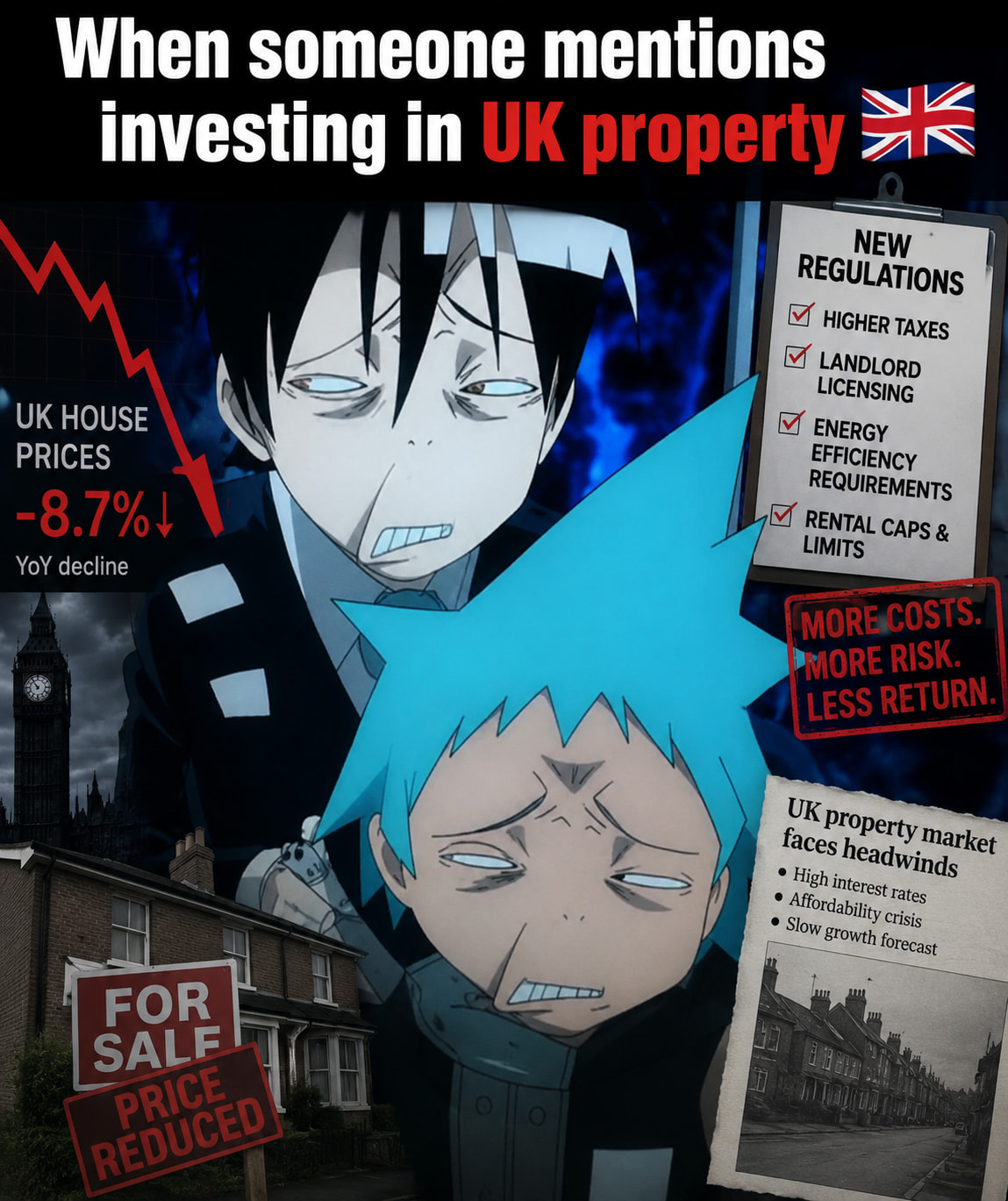
As covered here - In the UK a mans home is his castle no more
And here is the funny part. The capital does not vanish. It does not sulk under a mattress. It goes into US equities. It goes into Dubai. British investors are quietly propping up investment markets from Spain to Zanzibar, allocating capital all over the planet like the competent professionals they are. But mention a UK assets to these investors and the reaction is the same everywhere: meh, vomit, no thanks. Nobody wants to own an asset they cannot control, that is theirs in name only. The British investor didn’t stop investing. They just stopped investing in the UK as much quietly offshoring their wealth.

Meanwhile, who is getting rich in Britain? Look closely and a pattern appears: government contracts. The people doing well are, again and again, the ones with an arrangement with the state. Political entrepreneurs are thriving while actual entrepreneurs, the ones selling goods and services to willing customers, are struggling. An elite that gets wealthy through proximity to government rather than through the market. Remind you of any economic systems we used to point at and laugh?
## The state’s investing track record: fund, lose, repeat
Now for the insult on top of the injury. Having taxed private investors out of their own market, the government then berates them for not investing in UK companies and net zero projects, and decides that it, the state, will show everyone how investing is done.
How has that gone? My personal summary of UK government investing is three lines. The government invests in something. It loses money. The end.

Councils were encouraged to play fund manager, and they obliged. One example of many includes Thurrock Council borrowed and poured [£655 million into solar farm bonds](Bankrupt council loses £200m on solar farms) issued by one businessman’s companies, ended up facing a loss of around £200 million on the farms alone, spent tens of millions more on advisers trying to claw the money back, and finished the story effectively bankrupt with debts around £1.4 billion. That was residents’ money, collectivised by force through debt, council fees and government assurance, torched on deals the [Serious Fraud Office is now investigating](Thurrock chasing Liam Kavanagh over £200m solar scandal | TBIJ). Nobody meaningful has been held accountable. Nobody ever is.
Then there is the national level. The Future Fund, the state’s Covid era venture portfolio, has watched [at least 30 of its companies collapse](https://www.british-business-bank.co.uk/finance-options/legacy-programmes/future-fund), including a video conferencing startup that took £5 million of taxpayer money into administration and a musical instrument startup that burned through $75 million of everyone’s cash.
The Green Investment Bank was built, subsidised, and then sold off. The UK Infrastructure Bank was rebranded as the National Wealth Fund and handed [£27.8 billion](https://publications.parliament.uk/pa/cm5901/cmselect/cmtreasy/806/report.html) of public money to “unlock” private investment, because apparently the problem with British capital was never the taxes on it, it was the shortage of quangos.
And now Labour has launched its shiny new [£500 million Sovereign AI Fund](AI firms pioneering drug discovery, cheaper supercomputing and more get first backing through UK’s Sovereign AI - GOV.UK), so the same state that could not pick a solvent solar farm will now pick the winners of the most competitive technology race in human history, with cheques of £1 million to £10 million, which in frontier AI terms is a rounding error wearing a hi-vis jacket and holding a press release.
Notice the pattern across every party, because this is not a Labour disease. Labour wants a big state fund for net zero and AI. The Conservatives wanted big state funds for net zero. Reform wants a big state fund, just pointed at oil and gas instead. Richard Tice’s version is the same machine with a different sticker on it. Every party in British politics has looked at decades of the state lighting money on fire and concluded that the problem is the state doesn’t have enough matches.
And when you look up the returns on any of these vehicles, you get the same weasel sentence every time: "financial returns were not the primary objective.

As Mr O himself once said" If it doesn’t make money, it doesn’t make sense." That’s my mantra, and it should be carved above the Treasury’s front door.
A fund whose objective is not returns is not a fund. It’s a bonfire where only the staff who always seem to be related to the people who propose the funds creation get rich.
## The solution is to do nothing
Here is my radical, detailed, fully costed policy proposal: stop.

Scrap capital gains tax on UK investments. Scrap stamp duty on shares. Then do absolutely nothing else. No fund, no taskforce, no tsar, no strategy document with a Union Jack on the cover. The British public already contains an enormous pool of demonstrably good investors, good enough that half the world’s markets are being propped up by their allocations right now. Let them do at home what they are already doing everywhere else.
Think about what capital gains tax actually says. It says: you allocated capital well, you took the risk, you were right, and therefore the state, which has been wrong about essentially every investment it has ever made, will now confiscate a slice of your winnings and reallocate it to the things it thinks are good ideas but are not. The proven allocator is taxed so the proven incinerator can go again.
The UK state is not regulating its competing with its own population at investing, losing every round, and charging the winners an entry fee to keep the game going.

And the bill for this has arrived. For the first time in a long time, Britain is destroying wealthy people adjusted for inflation faster than it creates them with a 7% drop year on year.
More millionaires are leaving than arriving or being made, and it is the “being made” number that matters, because that number is growth itself. The government stares at that statistic and reaches for another fund.
A country that punishes the people who build wealth, confiscates the winnings of the people who grow it, and hands the proceeds to the only institution with a perfect record of losing it, does not have an undervalued stock market. The value is fair when you consider the investment environment it operates in and this is a betrayal of the capitalist class.